
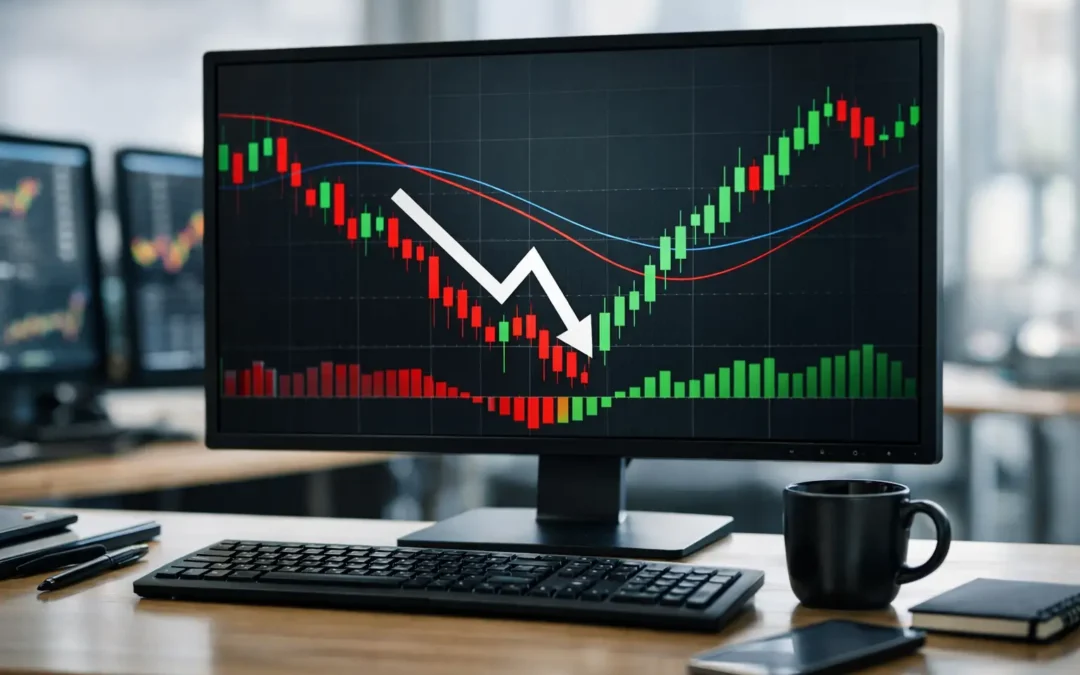
One bad reversal trade can wipe out the work of three good scalps. That is why the search for a reliable futures trend reversal indicator never really goes away, especially if you trade NQ, ES, GC, or CL on fast intraday charts. The real issue is not spotting movement after it happens. The real issue is recognizing when a trend is actually losing control, when momentum is shifting, and when a reversal has enough structure behind it to justify risk.
Most traders get trapped because they treat reversals like a single signal event. A candle pattern prints, an oscillator hooks, or price tags a moving average, and they jump in early. Then the market does what it often does in futures – pauses for a few bars, shakes out impatient traders, and continues in the original direction. If you want cleaner reversals, you need more than a flashy signal. You need context, confirmation, and a repeatable framework.
What a futures trend reversal indicator should actually do
A strong reversal tool is not just there to call tops and bottoms. That is amateur thinking, and it is expensive. A serious futures trend reversal indicator should help you measure when trend strength is fading, when counter-order flow is stepping in, and when price is beginning to transition from trend continuation to rotation or full directional change.
That means the indicator has to do three jobs well. First, it should show you when momentum is no longer supporting the existing move. Second, it should help define the price zone where reversal risk is real. Third, it should give you enough structure to place a stop loss in a logical spot instead of guessing.
This is where many off-the-shelf indicators fail. They give alerts, arrows, or color changes, but they do not teach you how to interpret the market around the signal. In futures trading, especially on 1-minute and 5-minute charts, raw signals without execution logic are noise.
Why most reversal signals fail on futures charts
Futures markets move differently from slow, clean textbook charts. NQ can reverse hard and reclaim an entire drop in minutes. CL can fake a turn, sweep a prior high, and dump straight through support. ES can look sleepy until it suddenly expands and traps both sides. If you use a reversal indicator without understanding this behavior, you will end up fading strength instead of timing actual change.
The biggest problem is that traders confuse pullbacks with reversals. A trend can pause, compress, and even produce a temporary opposite signal without actually changing direction. On a 1-minute chart that can look dramatic, but on a 5-minute chart it may be nothing more than a routine retracement.
The second problem is timing. Many indicators are either too early or too late. If the tool is too sensitive, it will fire on every minor hesitation. If it is too slow, the trade is already extended by the time confirmation appears. There is always a trade-off between early entry and higher confirmation. Serious traders accept that trade-off instead of pretending a perfect signal exists.
The best futures trend reversal indicator is usually a framework
If you are looking for one magic line that flips from bullish to bearish and solves reversal trading forever, you are looking in the wrong place. The best futures trend reversal indicator is usually a combination of price behavior, momentum shift, and structure recognition.
Price behavior matters first. If a market has been making higher highs and higher lows, a real reversal often starts with failure at extension, then a break in that rhythm. In simple terms, the market stops doing what it was doing well. Buyers can no longer push cleanly higher, or sellers can no longer press new lows with authority.
Momentum shift matters next. You want evidence that the prior side is losing force. That can show up through reduced expansion, weaker follow-through, repeated rejection at an extreme, or a momentum tool that stops confirming fresh highs or lows. The point is not the indicator alone. The point is whether momentum and price are still aligned.
Structure recognition is what turns the setup into a trade. A reversal worth taking usually forms around a key prior swing, session high or low, opening drive level, or a repeated intraday reaction zone. That gives your entry logic and your stop-loss logic real shape. Without that, you are just guessing where the market should turn.
How to judge reversal quality before you enter
A high-quality reversal setup usually has a story behind it. The market extends into an obvious level. The move begins to stall. The bars lose conviction. Attempts to continue start failing. Then price breaks a nearby structure level and confirms that the other side is gaining control. That sequence is very different from randomly fading a green candle after a strong trend.
This is where experienced traders separate themselves from signal chasers. They ask better questions. Is the market reversing from a meaningful area or from the middle of nowhere? Is volume expanding with the turn or drying up? Is the broader intraday context stretched enough to support a reversal, or is this more likely a pullback entry for continuation?
On NQ, a quality reversal often comes after aggressive extension where late buyers or sellers are vulnerable. On ES, you may need more patience because the market can hold structure longer before breaking. On GC and CL, reversals can be violent, so entry precision and stop placement become even more important. The instrument matters. A reversal model that works on ES may need tighter filtering on NQ and faster confirmation on crude.
Using a futures trend reversal indicator with entry and stop logic
A good indicator becomes far more powerful when it is tied to exact execution rules. If your indicator marks a possible turning point, you still need to know what confirms entry. For many active traders, that means waiting for a break of a short-term swing, a reclaim of a failed push, or a close back through a key trigger zone.
Your stop loss should sit where the trade idea is clearly wrong, not where the dollar amount feels comfortable. That sounds simple, but it is where many traders sabotage themselves. If a reversal short depends on a failed push above a prior high, then the stop belongs beyond that failure area. If the reversal long depends on defending a flush low and reclaiming structure, the stop belongs beyond the flush zone.
This is one reason indicator-based training matters so much. The tool alone is not enough. Traders need to know how to read the setup, how to avoid chasing, and how to place risk where the chart invalidates the idea. Ultimate Scalper has built a strong reputation around that exact process – not just showing signals, but teaching traders how to execute them with discipline.
What beginners and advanced traders should do differently
Beginners usually need more confirmation. That means fewer trades, better-defined zones, and less obsession with catching the absolute top or bottom. Waiting for structure to break and retest may feel slower, but it often improves consistency because it removes the temptation to predict.
Advanced traders can sometimes enter earlier, but only because they have more screen time and better pattern recognition. They understand when a reversal is forming inside a broader auction and when the market is simply pausing before continuation. Even then, experience does not remove risk. It just improves decision quality.
There is also a personality factor. Some traders are built for first-pullback continuation setups and should only take reversals selectively. Others are excellent at reading exhaustion and trapping late momentum. It depends on your decision speed, discipline, and tolerance for heat on the trade. The right reversal indicator should support your style, not fight it.
What to avoid when choosing a reversal tool
Be careful with indicators that promise nonstop winning reversals or claim to identify every turning point. Futures markets are too dynamic for that. You want a tool that helps you read probabilities, not fantasy.
Also avoid tools that look amazing in screenshots but provide no execution guidance. A chart full of perfect arrows after the move means very little if the real-time signal was late, inconsistent, or impossible to trade with a sane stop. Clean marketing is easy. Repeatable intraday execution is hard.
Finally, do not judge a reversal indicator in isolation from your trading process. If you have no session plan, no market selection criteria, and no rules for trade management, even a strong signal tool will underperform. Indicators amplify discipline. They do not replace it.
The traders who get the most from reversal signals are usually the ones who stop chasing prediction and start focusing on structure, momentum, and execution. Once you make that shift, the chart gets quieter, your entries get sharper, and reversals start looking less like random hope and more like a real edge.