
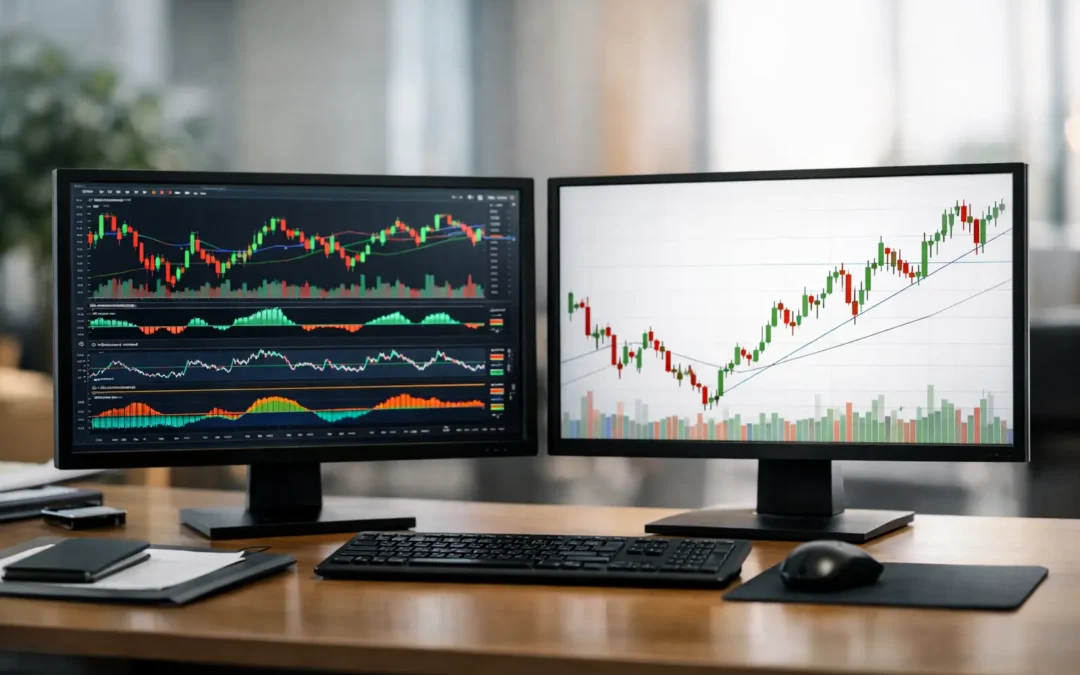
If you have ever stared at an NQ or ES chart and felt torn between reading raw candles or waiting for a signal to confirm the move, you are asking the right question. The futures indicators vs price action debate matters because short-term futures trading is not won by opinions. It is won by timing, structure, and risk control when the market is moving fast.
A lot of traders get pushed into extreme camps. One group says indicators are lagging, useless, and a crutch. The other says price action is too subjective and leaves traders guessing. Both arguments miss the real issue. In active futures trading, the question is not which side sounds smarter. The question is which approach helps you identify a trade, manage the stop, and execute without hesitation.
Futures indicators vs price action: what are you really comparing?
Price action is the direct reading of what the market is printing on the chart. Candles, swing highs and lows, failed breakouts, trend legs, pullbacks, rejection wicks, and consolidation all fall into this category. Traders who rely on price action want to read the auction itself without extra layers.
Indicators take market data and process it into signals, levels, visual cues, or patterns. That can include moving averages, momentum tools, order-flow style logic, trend filters, or proprietary systems designed to identify entries and reversals. A serious indicator is not supposed to replace chart reading. It is supposed to organize information faster than the eye can do it under pressure.
That distinction matters. Retail traders often compare bad indicator usage against idealized price action reading. That is not a fair comparison. A random trader loading ten lagging studies onto a 1-minute CL chart is not using indicators correctly. In the same way, a trader saying they use pure price action often still relies on structure, levels, session behavior, and repeatable setups that function like a system.
Why price action traders are right about some things
Price action gives you context that no single indicator can fully capture. You can see whether the market is compressing before a break, whether a breakout is weak, whether buyers are failing at a prior high, or whether momentum is accelerating into a key level. That kind of reading is valuable, especially in fast intraday futures markets.
It also keeps you close to the source. On NQ, for example, a clean rejection from a prior session high can tell an experienced trader more in two candles than a generic oscillator can tell them in twenty minutes. Price action forces you to pay attention to behavior, not just colored dots or arrows.
The problem is that price action is often sold as simpler than it really is. It is not simple. It is discretionary. Two traders can look at the same chart and see two different stories. One sees a bull flag. Another sees a weak retest before a flush. That subjectivity is exactly why so many traders hesitate, chase, or enter late.
For newer traders, price action alone can become a trap. They start naming every candle pattern they have ever learned, but they still do not know where to enter, where the stop goes, or what invalidates the trade. Raw chart reading without a structured process can feel advanced while producing inconsistent results.
Why indicator traders are right about some things
Good indicators can remove noise, speed up decision-making, and create repeatable rules. That is a major advantage for scalpers and short-term futures traders who need clear execution on 1-minute and 5-minute charts. If your tool helps identify trend direction, likely reversals, and exact entry zones, you are not weakening your trading. You are building consistency.
This is where experienced system design changes the conversation. A well-built indicator framework is not about decorating a chart. It is about reducing the lag between what the market is doing and what the trader is able to recognize. In real trading, that matters. A delayed read on ES might cost a few points. A delayed read on NQ can turn a clean setup into a poor chase very quickly.
Indicators also help with the hardest part of trading for most retail traders: discipline. When traders rely only on feel, they tend to override their own rules. When they have a defined signal process tied to trend, reversal logic, and stop placement, they are much more likely to execute the same way each session.
Of course, indicators have a weakness too. If they are too generic, too slow, or too disconnected from actual market structure, they create false confidence. A signal without context is not an edge. It is just an instruction. That is why traders who blindly follow indicators often get chopped up in consolidation and trapped at obvious failure points.
Futures indicators vs price action on real intraday charts
In live futures markets, this debate usually comes down to three things: speed, clarity, and repeatability.
Price action is excellent for context. It helps you understand whether a move is expanding, stalling, trapping, or reversing. It shows the shape of the market. But by itself, it can be slow to standardize. You may recognize the setup, but not quickly enough to get the exact entry.
Indicators are excellent for clarity. They can mark the setup, identify trend pressure, and tighten the decision window. But without price action context, they can tempt traders into taking every signal as if all signals are equal. They are not.
That is why the strongest traders usually operate with both. They read price action to understand location and behavior, then use indicators to sharpen execution. That blend is practical, not theoretical. It gives the trader context from the chart and commitment from the signal.
A pullback long in ES is a good example. Price action might tell you the market is holding higher lows above a key intraday level. An indicator-driven framework can then help define the exact trigger, the stop placement, and whether momentum supports taking the trade now rather than two bars later. That is where precision shows up.
The mistake beginners make with both approaches
Beginners often think they need to choose one camp and reject the other. That is the wrong move.
If you trade only price action, you may end up with broad observations and weak execution. If you trade only indicators, you may take mechanically correct signals in completely wrong locations. Neither side solves the whole problem by itself.
The better question is this: does your method help you read trend, identify reversals, define risk, and execute with consistency? If the answer is no, then the method is incomplete, no matter how pure it sounds.
This is especially true in markets like GC and CL, where intraday movement can be sharp and emotional. Traders who lack a framework get baited into noise. They confuse movement with opportunity. A systematized approach, supported by high-quality indicators and real chart training, can keep them focused on high-probability structure instead of random fluctuations.
What serious futures traders should use
The best answer in the futures indicators vs price action conversation is not either-or. It is layered decision-making.
Use price action to read the story. Is the market trending, balancing, rejecting, or trapping? Are buyers defending an area, or are they losing control? Is the breakout clean, or is it already showing failure?
Use indicators to convert that story into action. Where is the exact trigger? Where does the stop logically belong? Is the move aligned with trend pressure or flashing reversal risk? Can the setup be repeated tomorrow under similar conditions?
That is the difference between casual chart watching and professional execution. Traders who want exact entries, sharper reversals, and cleaner stops need more than opinions about candlesticks. They need a framework that sees what matters fast enough to act on it.
That is why so many active traders eventually move toward a blended model. They still respect price action, but they stop pretending that raw chart reading alone is the fastest path to consistency. They want tools that help them trade with precision instead of interpretation overload. Ultimate Scalper has built its reputation around that exact idea: combining chart logic, proprietary indicators, and direct instruction so traders can stop guessing and start executing with intent.
If your current approach leaves you late, uncertain, or too loose with stops, the answer is not more random screen time. It is building a method where price action gives you context and indicators give you commitment. That is where confidence starts to become skill.