
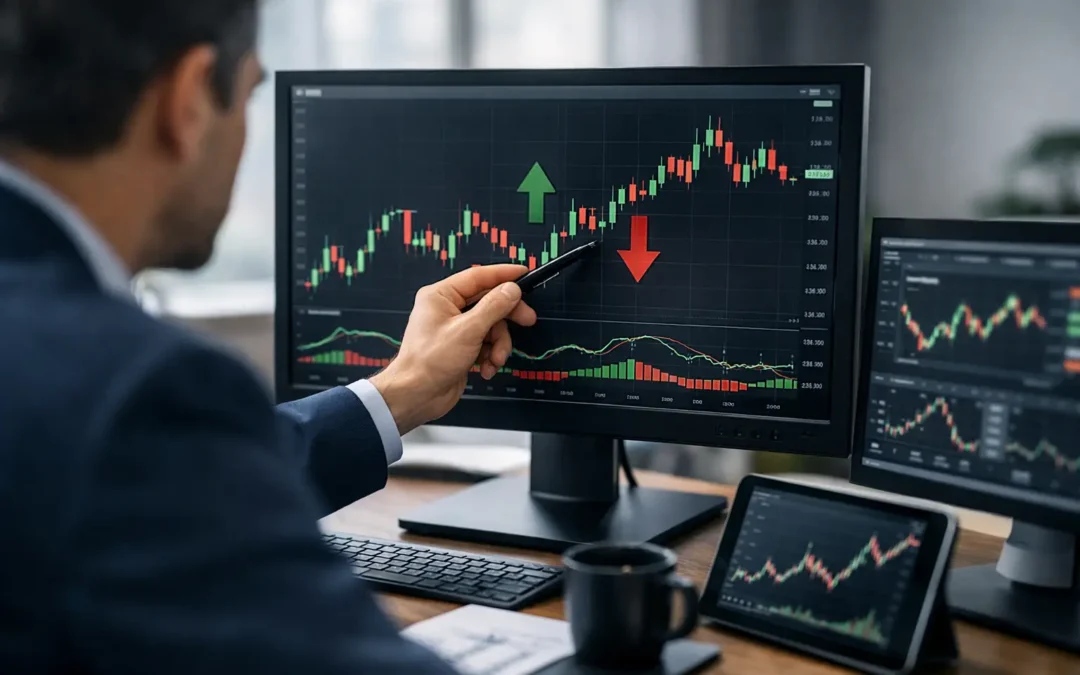
Most traders do not lose because they never see a signal. They lose because they read the signal too late, too early, or completely out of context. If you want to know how to read futures signals, start there. A signal is not a magic arrow on a chart. It is a decision point. Your job is to read what the market is doing around that decision point so you can act with precision instead of hope.
That matters even more in fast futures markets like NQ, ES, GC, and CL. These contracts move hard, they punish hesitation, and they expose sloppy trade selection fast. The trader who treats every alert the same gets chopped up. The trader who reads location, momentum, and follow-through has a real edge.
What futures signals are actually telling you
A futures signal is a visual or rule-based clue that price may continue, stall, reverse, or accelerate. Sometimes that comes from an indicator. Sometimes it comes from price action. The best traders use both. They do not just ask, “Did a signal print?” They ask, “What is this signal saying about buyers and sellers right now?”
That shift in thinking changes everything. A buy signal near the middle of a messy range does not mean much. A buy signal after a pullback in a strong trend, printed at support with momentum coming back in, is a completely different trade. Same signal type, different quality.
This is where many retail traders get trapped. They look for certainty when the real work is ranking probability. Reading signals well means grading them. Some are A setups. Some are obvious passes. Discipline starts with that distinction.
How to read futures signals in context
Context is the filter that keeps you out of bad trades. Without it, even a cutting-edge signal system gets misused. With it, you stop chasing every flashing light on the chart.
Start with trend. If the market is making higher highs and higher lows, bullish signals deserve more respect than bearish ones. If price is stair-stepping lower, short signals usually carry more weight. That does not mean countertrend trades never work. It means they require better location and tighter risk control.
Next, read where the signal appears. A long signal into resistance is weaker than a long signal after a clean pullback above support. A short signal right on top of major support is asking for trouble. Location is not a small detail. It is often the difference between a high-probability continuation and a low-quality trap.
Then look at speed. Futures markets often tell you the truth through urgency. If a signal appears and the next bars confirm with strong expansion, that is useful information. If the signal prints and price immediately stalls, overlaps, or snaps back, that is a warning. Good signals tend to attract fast agreement. Weak signals often sit there and make traders negotiate with themselves.
The three signals inside every setup
When traders ask how to read futures signals, they usually focus on the entry marker. That is too narrow. A solid setup contains three separate signals.
The first is the directional signal. This tells you whether the market is favoring long or short. It might come from trend structure, a bias indicator, or a sequence of higher lows and failed breakdowns.
The second is the timing signal. This is the actual trigger. It could be a momentum shift, a reversal bar, a reclaim of a key level, or a proprietary indicator firing at the right spot. Timing matters because being right on direction but wrong on timing can still cost you money.
The third is the risk signal. This is where many traders act like amateurs. Every good setup should also tell you where the trade is wrong. If you cannot identify a clean invalidation point, the signal is not ready. Strong systems do not just tell you where to get in. They help define where the stop belongs and whether the trade is worth taking at all.
Reading continuation signals versus reversal signals
Continuation signals and reversal signals should never be read the same way. That mistake burns accounts every week.
A continuation signal works best when the market already has directional control. You want to see trend, a pause, then re-acceleration. On a 1-minute or 5-minute chart, this often looks like a push, a pullback, and then a clean resumption. In these cases, the signal is confirming existing strength. These trades are often cleaner because they align with current order flow.
A reversal signal is different. Here, you are looking for exhaustion, failure, and a shift in control. A reversal signal has more weight if it appears after an extended move, near an obvious level, with momentum fading and the other side unable to push further. If you try to call reversals in the middle of a trend with no sign of weakness, you are not reading signals. You are guessing.
That is why experienced traders do not get excited by every reversal marker. They want proof. They want to see the market fail first.
How chart timeframe changes the signal
A futures signal on a 1-minute chart can be valid and still fail because the 5-minute chart is pushing the other way. This is one of the biggest reasons traders feel like signals are inconsistent. The problem is often not the signal. The problem is a mismatch between execution timeframe and market structure.
If you scalp, the 1-minute chart may give your entry, but the 5-minute chart often gives your map. If the higher timeframe is trending hard, lower-timeframe countertrend signals become lower quality. If both timeframes line up, signal quality improves.
This is where a mentor-driven process matters. You need a framework that teaches when to trust the first signal and when to wait for confirmation. Precision is not random. It comes from reading multiple layers of the chart together.
Common mistakes when reading futures signals
The first mistake is taking signals in dead zones. Mid-range entries, lunchtime chop, and low-energy drift can make almost any signal look worse than it is. The market has to be in a tradeable state.
The second mistake is entering late. Traders see a signal, hesitate, then chase after the move has already expanded. That ruins the stop placement and distorts the reward. A great setup entered badly can become a bad trade.
The third mistake is ignoring failed signals. Failed signals are not useless. They often reveal the stronger side of the market. If a bullish signal cannot lift price and gets rejected immediately, that failure itself can become powerful information for a short bias.
The fourth mistake is treating indicators like substitutes for skill. Indicators can be game-changing tools, but only when paired with chart reading, execution rules, and repetition. No serious trader should want blind signals. You want exact entries supported by real structure.
How to build confidence reading futures signals
Confidence does not come from taking more trades. It comes from seeing the same setup enough times that you know what strong looks like and what weak looks like.
Study charts bar by bar. Mark where the signal appeared, what the broader trend was, where support or resistance sat, and whether momentum confirmed the move. Then compare winning signals to losing ones. You will start seeing patterns fast. The strongest signals usually share the same traits. So do the junk trades.
This is also why structured tools and training matter. A serious trading framework should not just throw alerts at you. It should teach you how to interpret those alerts, how to place stops, and how to recognize when a trend is likely continuing versus when a reversal is setting up. That is the difference between being dependent on a chart tool and becoming dangerous with it.
Ultimate Scalper has built its reputation around that exact idea – combining signals, chart execution, and trader education so you are not left guessing in live markets.
How to read futures signals with discipline
The best signal readers are not the most emotional traders. They are the most selective. They know that not every chart owes them a trade. They wait for alignment. They want trend, location, timing, and risk to line up before they hit the button.
That does not mean every trade wins. Futures trading does not work that way. Some perfect-looking setups fail. Some ugly ones run. But disciplined signal reading keeps you in the probability game instead of the impulse game.
If you want sharper entries on NQ, cleaner reversals on ES, better stop placement on GC, or more confidence reading CL volatility, stop asking whether a signal exists and start asking whether it deserves your capital. That is when your chart stops looking like noise and starts reading like opportunity.
The market is always speaking. Your edge comes from learning which signals matter, which ones are weak, and when to stay flat long enough for the real trade to show itself.