
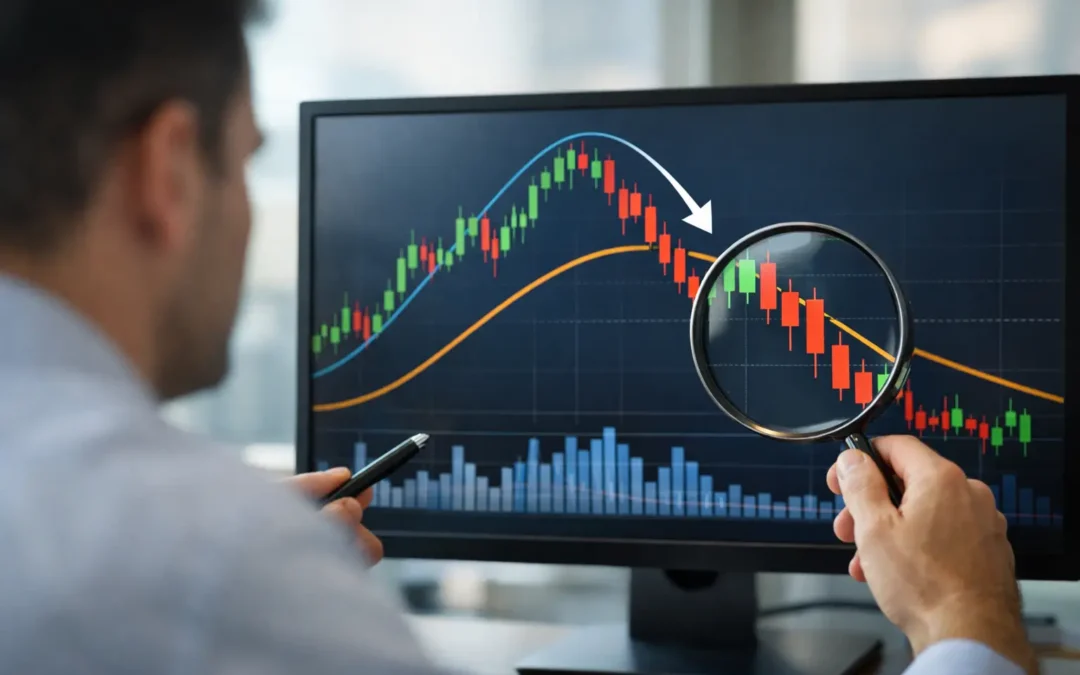
Most traders do not lose money because they cannot find a trend. They lose money because they mistake a pullback for a reversal, or worse, they chase the old move right when the market is running out of fuel. If you want to learn how to spot trend reversals, you need more than a guess, a feeling, or one candle that looks dramatic on a 1-minute chart.
Real reversals leave clues. The problem is that most traders either see them too late or trust weak signals too early. In active futures markets like NQ, ES, GC, and CL, a true turn usually shows up through a combination of structure, momentum, failed continuation, and reaction at a meaningful price area. One signal alone is rarely enough. Serious traders learn to read the stack.
How to spot trend reversals without guessing
A reversal is not just a market moving the other way for two or three bars. A reversal is a shift in control. Buyers stop being able to defend higher prices, or sellers stop being able to push lower. That shift usually happens in stages.
First, the trend starts losing efficiency. The drive becomes choppy. Impulse legs get shorter. Pullbacks get deeper. Then price reaches an area where traders care – prior highs or lows, session extremes, VWAP zones, key intraday structure, or a major measured move completion. After that, you often see failure. The breakout does not hold. The next push stalls. Aggressive traders get trapped. That is where a real opportunity starts to form.
If you are trying to call tops and bottoms on every extended move, you are not spotting reversals. You are predicting. Those are two different things. The best reversal traders are not magicians. They are patient enough to wait for evidence.
The four clues that matter most
Price structure is the first thing to watch. In an uptrend, price should keep making higher highs and higher lows. In a downtrend, it should keep making lower lows and lower highs. A possible reversal begins when that pattern breaks. If an uptrend fails to make a new high and then breaks the prior swing low, that is not random noise. It is the market telling you buyers are losing control.
Momentum is the next clue. Strong trends move cleanly. They push with conviction and spend very little time hesitating. When momentum fades, you start seeing sluggish extension, overlapping bars, and weaker follow-through after breakout attempts. This matters because many reversals start with exhaustion, not immediate collapse. The market often warns you before it turns.
Volume can help, but only if you use it intelligently. A reversal after a major push often comes with either climactic volume at the extreme or a clear lack of participation on the final leg. In simple terms, if price stretches to a fresh high but the move feels thin and cannot attract fresh buyers, that breakout is vulnerable. On the other side, if heavy volume hits a key level and the market rejects it hard, trapped traders can fuel the turn.
Context ties everything together. A weak-looking candle in the middle of nowhere means very little. The same candle at prior session highs, after an extended move, with fading momentum and failed continuation, means a lot more. Location is not a side detail. It is the filter that separates noise from a real setup.
Why failed breakouts are so powerful
One of the cleanest reversal signals in short-term trading is the failed breakout. This happens when price pushes above resistance or below support, attracts breakout traders, and then quickly snaps back into the prior range. That is a strong sign that the market is rejecting higher or lower prices.
Failed breakouts matter because they trap the wrong traders at the worst location. When those traders have to exit, their pain adds fuel to the reversal. That is why many of the best intraday turns are not slow and polite. They are sharp. Once the trap is recognized, the move can accelerate fast.
This is especially useful on the 1-minute and 5-minute charts, but it works best when you know what level actually matters. Not every breakout failure is worth trading. A failure at a random intrabar line is weak. A failure at the prior day high, opening range extreme, or a major session level has teeth.
Watch the pace, not just the pattern
A lot of traders get too focused on candle shapes and ignore the speed of the market. Pace tells you whether pressure is expanding or fading. A trend that was moving fast and suddenly starts grinding is giving you information. A downtrend that cannot produce another clean flush after several attempts is often close to turning, especially if buyers start holding higher lows.
This is where experienced chart readers separate themselves. They do not just ask, “Do I see a reversal pattern?” They ask, “Is the auction changing character?” That is a stronger question. It keeps you focused on behavior, not decoration.
How to spot trend reversals using confirmation
The biggest mistake traders make is entering on the first sign of resistance or support and assuming the reversal has already begun. Strong trends can stay strong longer than most traders expect. That is why confirmation matters.
Confirmation can come in several forms. Price breaks a key swing point. A failed breakout gets rejected and cannot reclaim the level. Momentum shifts with stronger countertrend bars. A retest holds and then launches. These are all signs that control may actually be changing hands.
There is always a trade-off here. Early entries can offer better risk-reward, but they also carry more false starts. Waiting for confirmation can reduce the number of bad trades, but it may cost you part of the move. That is not a flaw. That is trading. Your job is to choose the style that matches your system and risk tolerance.
For most retail traders, confirmation is the smarter path. It keeps you from fighting strong trends just because the move feels overextended. Markets do not reverse because they look stretched. They reverse when order flow changes and structure breaks.
Common reversal traps traders fall for
The first trap is confusing a pullback with a trend change. Every trend breathes. If you short every red candle in an uptrend or buy every green candle in a downtrend, you will get chopped apart. A pullback becomes more meaningful only when it breaks the structure that defines the trend.
The second trap is relying on one indicator with no chart context. Oscillators can stay overbought or oversold for a long time in powerful markets. That does not make them useless, but it does mean they should support your read, not replace it.
The third trap is entering before the market proves anything. Traders see one wick at a high and jump in front of a freight train. Then they call it manipulation when the trend resumes. What really happened is simpler – they traded hope instead of evidence.
The fourth trap is ignoring the bigger time frame. Even if you scalp the 1-minute chart, the market does not stop caring about higher time frame levels. A small reversal setup against a strong larger trend may only produce a quick scalp. That can still be a valid trade, but you need realistic expectations.
Building a repeatable reversal process
If you want consistency, stop hunting random turning points and build a process. Start with location. Mark the levels where a reversal would matter. Then assess trend quality. Is the move still clean and aggressive, or is it losing power? Next, watch for failure. Did the breakout hold, or did it trap traders? After that, wait for confirmation through structure, momentum, or a retest.
This process is not flashy. That is exactly why it works. The traders who survive are not chasing every dramatic candle. They are stacking probabilities.
A serious indicator-driven approach can help speed up this read, especially when you are trading fast markets and need exact entries, stop-loss logic, and clearer trend signals. That is one reason many active traders use tools from Ultimate Scalper – not to replace judgment, but to bring more structure to reversal recognition when seconds matter.
The goal is not to catch every reversal. The goal is to identify the ones with enough evidence behind them to justify risk. That mindset alone can change your trading.
When the market starts stalling at a key level, breakout attempts fail, momentum fades, and structure shifts, pay attention. You do not need to be first. You need to be right often enough, with discipline, when the market finally shows its hand.